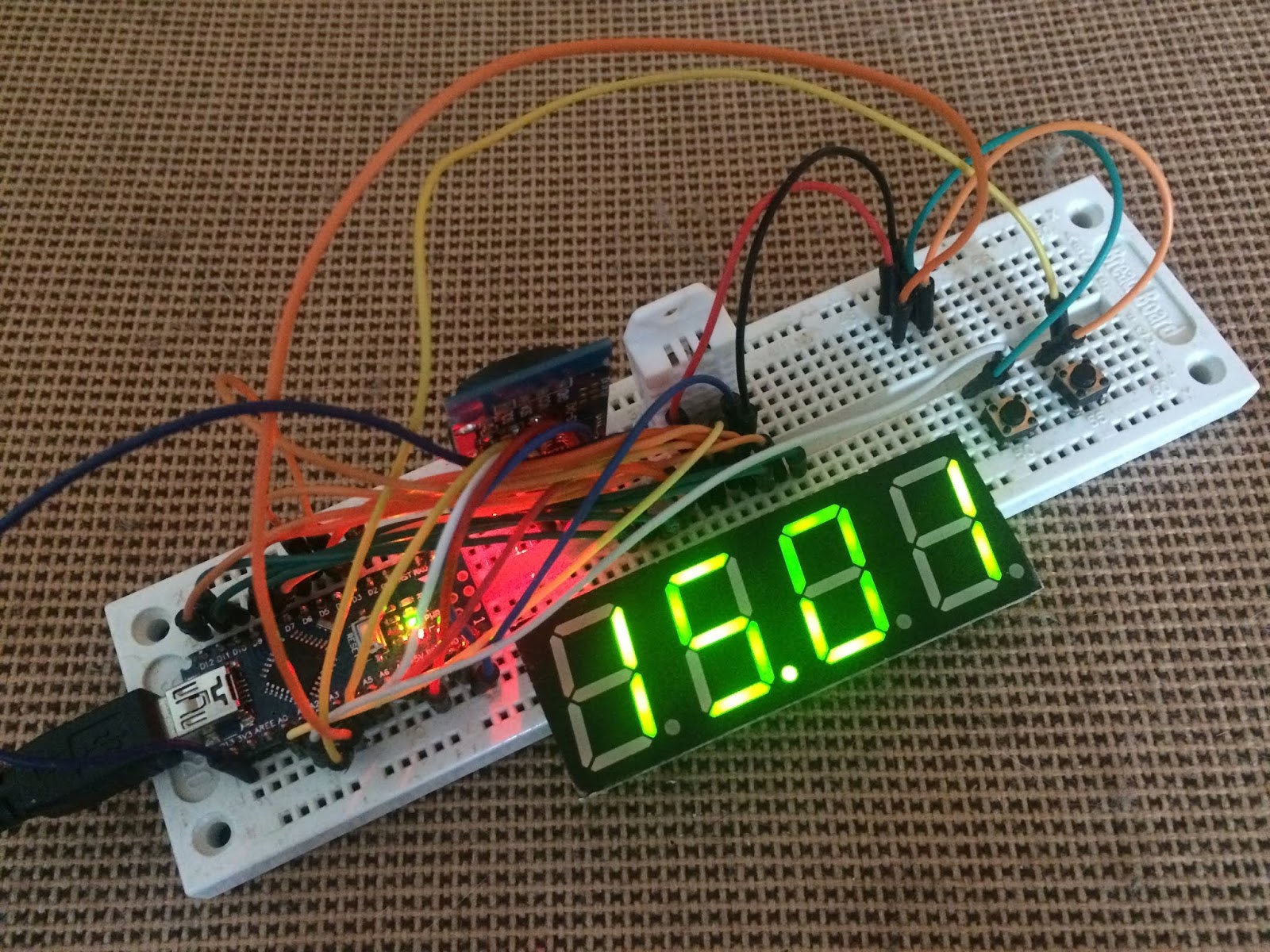
Am adăugat ceasului cu prezentare informaţii animate şi reglaj al ceasului şi datei, pentru a putea avea un ceas independent. Am păstrat si reglajul intensităţii (automat sau manual) cum e prezentat în articolul precedent.
sau
Am adăugat doar 2 butoane fără reţinere (pushbutoane) la pinii A1, respectiv A2:
Schema de bază rămânând aceeaşi
Apăsând butonul MENU/MENIU se intră în modul de reglaj, întâi al orelor care clipesc repede şi creşte valoare la fiecare apăsare a butonului +, dar dacă se ajunge la 23 şi s eappară o să avem ora 00.
Dacă se apasă iar butonul MENIU se intră în meniul de reglare al minutelor, care clipesc mai repede, iar valoarea lor creşte prin apăsarea butonului + (sau menţinerea apăsată pentru creştere mai rapidă) până la 59, după care trece la 00.
La următoarea apăsare a butonului MENIU apare anul, care poate fi schimba doar de la 2018 la 2049
urmează schimbarea lunilor de la 1 la 12
apoi prin apăsarea butonului MENIU se intră la reglarea zilelor, care depind de luna şi an (pentru februarie), în acest mod zilele clipesc rapid pentru a şti ce se modifică
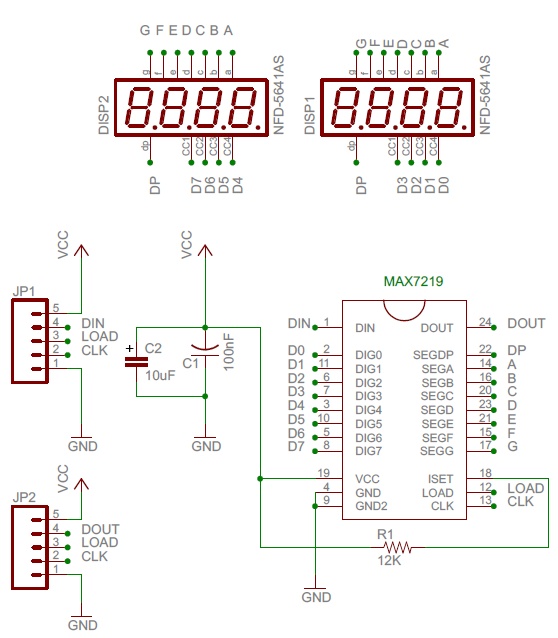
Am achizitionat de pe Banggood.com un modul de afisare cu 8 cifre LED din 7 segmente fiecare, care sunt comandate de integratul MAX7219. MAX7219 poate controla 64 de LED-uri, cum e cazul acestor 8 cifre din 7 segmente + punctul zecimal la fiecare sau o matrice de 8x8 LED-uri.
In acel articol sunt prezentate niste scurte exemple, in care se utilizeaza libraria LedControl.h si din comenzile de acolo am facut schema:
Am incercat si eu sketch-urile din articol si din exemplu, modificand unul pentru a afisa cum vreau sa afisez pentru o viitoare statie meteo cu ceas:
si un anume text:
Sketch-ul folosit de mine este:
// adapted sketch by niq_ro from http://www.tehnic.go.ro// http://nicuflorica.blogspot.ro/// http://arduinotehniq.blogspot.com/// orginal sketch from http://embedded-lab.com/blog/?p=6862
#include "LedControl.h"/* Now we need a LedControl to work with. ***** These pin numbers will probably not work with your hardware ***** pin 12 is connected to the DataIn pin 11 is connected to the CLK pin 10 is connected to LOAD We have only a single MAX72XX. */LedControl lc=LedControl(12,11,10,1);
voidsetup()
{
// Initialize MAX7219 device
lc.shutdown(0,false); // Enable display
lc.setIntensity(0,15); // Set brightness level (0 is min, 15 is max)
lc.clearDisplay(0); // Clear display register //}
}
voidloop()
{
// test afisare un anumit text
lc.clearDisplay(0); // Clear display register
lc.setDigit(0,7,2, false); // afisez un 2 pe prima coloana din stanga (coloane 7)
lc.setDigit(0,6,5, true); // afisez un 5 pe coloana 6 si un punct zecimal
lc.setDigit(0,5,4, false); // afisez un 4 pe coloana 5
lc.setRow(0,4,B1001110);
lc.setDigit(0,2,3, false); // afisez un 5 pe coloana 2
lc.setDigit(0,1,7, false); // afisez un 0 pe coloana 1
lc.setRow(0,0,B0110111);
delay(3000);
// fac alt text
lc.clearDisplay(0); // Clear display register
lc.setDigit(0,7,1, false); // afisez un 1 pe prima coloana din stanga (coloane 7)
lc.setDigit(0,6,2, false); // afisez un 2 pe coloana 6 si un punct zecimal
lc.setRow(0,5,B00000001);
lc.setDigit(0,4,4, false); // afisez un "4" pe coloana 4
lc.setDigit(0,3,2, false); // afisez un "2" pe coloana 3
lc.setRow(0,2,B00000001);
lc.setDigit(0,1,3, false); // afisez un 3 pe coloana 1
lc.setDigit(0,0,6, false); // afisez un 6 pe prima coloana din dreapta, pe coloana 0delay(3000);
// fac inca un text
lc.clearDisplay(0); // Clear display register
lc.setRow(0,6,B01100010); // "n" sus
lc.setRow(0,5,B00100000); // "i" sus
lc.setRow(0,4,B01110011); // "q" sus
lc.setRow(0,3,B00000001); // bara la mijloc
lc.setRow(0,2,B01000010); // "r" sus
lc.setRow(0,1,B01100011); // "o" susdelay(3000);
}
dar apar variatii bruste de temperaturi: 24, 25 sau 260C, care ma deranjeaza. Sketch-ul scris de mine, din combinarea altora, care folosesc librariile LedControl.h si DHT.h este:
// adapted sketch by niq_ro from http://arduinotehniq.blogspot.com// and http://nicuflorica.blogspot.ro// version 1.0 in 6.11.2014, Craiova - Romanaia// source for LEDControl: http://embedded-lab.com/blog/?p=6862
#include "LedControl.h"/* Now we need a LedControl to work with. ***** These pin numbers will probably not work with your hardware ***** pin 12 is connected to the DataIn pin 11 is connected to the CLK pin 10 is connected to LOAD We have only a single MAX72XX. */LedControl lc=LedControl(12,11,10,1);
// Example testing sketch for various DHT humidity/temperature sensors// Written by ladyada, public domain
#include "DHT.h"
#define DHTPIN 7 // what pin we're connected to D7// Uncomment whatever type you're using!
#define DHTTYPE DHT11 // DHT 11 //#define DHTTYPE DHT22 // DHT 22 (AM2302)//#define DHTTYPE DHT21 // DHT 21 (AM2301)// if is just sensor:// Connect pin 1 (on the left) of the sensor to +5V// Connect pin 2 of the sensor to whatever your DHTPIN is// Connect pin 4 (on the right) of the sensor to GROUND// Connect a 10K resistor from pin 2 (data) to pin 1 (power) of the sensor
DHT dht(DHTPIN, DHTTYPE);
// decralaration for type of valueint t, h;
voidsetup()
{
// Initialize MAX7219 device
lc.shutdown(0,false); // Enable display
lc.setIntensity(0,11); // Set brightness level (0 is min, 15 is max)
lc.clearDisplay(0); // Clear display register // Initialize HTD sensor
dht.begin();
}
voidloop()
{
// Reading temperature or humidity takes about 250 milliseconds!// Sensor readings may also be up to 2 seconds 'old' (its a very slow sensor)
h = dht.readHumidity();
t = dht.readTemperature();
/* test part // test humidity valueh = 37;// test temperature valuet = 19;*///
temperatura (t);
umiditate (h);
delay(10000);
}
void umiditate (int umidit)
{
int zu = int(umidit/10); // determin cifra zecilorint uu = umidit - 10*zu; // determin cifra unitatilor
lc.setDigit(0,2,zu, false); // afisez un 5 pe coloana 2
lc.setDigit(0,1,uu, false); // afisez un 0 pe coloana 1
lc.setRow(0,0,B0110111); // afisez litera "H"
}
void temperatura (int temper)
{
int zt = int(temper/10); // determin cifra zecilorint ut = temper - 10*zt; // determin cifra unitatilor
lc.setDigit(0,7,zt, false); // afisez un 5 pe coloana 7
lc.setDigit(0,6,ut, false); // afisez un 0 pe coloana 1
lc.setRow(0,5,B1100011); // afisez un semn de grad pe coloana 5
lc.setRow(0,4,B1001110); // afisez un C pe coloana 4
}
Apoi am facut o medie de 9 masuratori si a ultimei temperaturi afisate, fiecare masuratoare fiind la 2 secunde, obtinand ceva mai aproape de adevar:
Sketch-ul adaptat si scris de mine este:
// adapted sketch by niq_ro from http://arduinotehniq.blogspot.com// and http://nicuflorica.blogspot.ro// version 1.2 in 6.11.2014, Craiova - Romania// source for LEDControl: http://embedded-lab.com/blog/?p=6862
#include "LedControl.h"/* Now we need a LedControl to work with. ***** These pin numbers will probably not work with your hardware ***** pin 12 is connected to the DataIn pin 11 is connected to the CLK pin 10 is connected to LOAD We have only a single MAX72XX. */LedControl lc=LedControl(12,11,10,1);
// Example testing sketch for various DHT humidity/temperature sensors// Written by ladyada, public domain
#include "DHT.h"
#define DHTPIN 7 // what pin we're connected to D7// Uncomment whatever type you're using!
#define DHTTYPE DHT11 // DHT 11 //#define DHTTYPE DHT22 // DHT 22 (AM2302)//#define DHTTYPE DHT21 // DHT 21 (AM2301)// if is just sensor:// Connect pin 1 (on the left) of the sensor to +5V// Connect pin 2 of the sensor to whatever your DHTPIN is// Connect pin 4 (on the right) of the sensor to GROUND// Connect a 10K resistor from pin 2 (data) to pin 1 (power) of the sensor
DHT dht(DHTPIN, DHTTYPE);
// decralaration for type of valueint t, h;
float tmed;
int tmed1;
voidsetup()
{
// Initialize MAX7219 device
lc.shutdown(0,false); // Enable display
lc.setIntensity(0,11); // Set brightness level (0 is min, 15 is max)
lc.clearDisplay(0); // Clear display register // Initialize HTD sensor
dht.begin();
// inital value for tmperature
tmed = 200;
}
voidloop()
{
// Reading temperature or humidity takes about 250 milliseconds!// Sensor readings may also be up to 2 seconds 'old' (its a very slow sensor)
h = dht.readHumidity();
tmed = tmed/10;
for(int i = 9 ; i >0 ; i--) {
t = dht.readTemperature();
tmed = tmed + t;
delay(2000);
}
tmed1 = tmed; // valoarea de inmultita cu zere pentru usurinta afisarii/* test part // test humidity valueh = 37;// test temperature valuet = 19;*///
temperatura (tmed1);
umiditate (h);
delay(1000);
}
void umiditate (int umidit)
{
int zu = int(umidit/10); // determin cifra zecilorint uu = umidit - 10*zu; // determin cifra unitatilor
lc.setDigit(0,2,zu, false); // afisez un 5 pe coloana 2
lc.setDigit(0,1,uu, false); // afisez un 0 pe coloana 1
lc.setRow(0,0,B0110111); // afisez litera "H"
}
void temperatura (int temper)
{
int st = int(temper/100); // determin cifra sutelor
temper = temper - 100*st; // restul numarului de la zeci si unitati int zt = int(temper/10); // determin cifra zecilorint ut = temper - 10*zt; // determin cifra unitatilor
lc.setDigit(0,7,st, false); // afisez un 5 pe coloana 7
lc.setDigit(0,6,zt, true); // afisez un 0 pe coloana 1 si virgula
lc.setDigit(0,5,ut, false); // afisez un 5 pe coloana 7//lc.setRow(0,5,B1100011); // afisez un semn de grad pe coloana 5
lc.setRow(0,4,B1001110); // afisez un C pe coloana 4
}
Din dorinta de a putea vedea temperaturile de la distanta cat mai mare pe un afisaj alfanumeric cu 16 coloane si 2 randuri, LCD16x2 sau 1602, am folosit caractere mari (util 3 coloane + un spatiu, pe ambele randuri), dupa cum am prezentat in articolul anterior, Caractere mari pe afisaj de 2 randuri si 16 coloane si... Arduino (2):
Dupa acesta comparatie, pot spune ca e mai avantajos din punct de vedere economic sa folosim un afisaj LED, cat si al consumului, deoarece comanda la cel LED e multiplexata, deci se aprinde pe rand doar o cifra/simbol, iar la cel LCD e LED-ul de fundal plus consum afisaj.. dar partea importanta e aceea de vizibilitate, care este tot in favoarea afisajului clasic, tip LED.
In articolul precedent am folosit pentru partea ceas propriu-zis (ore si minute) informatiile oferite de un ceas de timp real cu DS1307, acum o sa folosesc libraria Time.h care se bazeaza pe functia millis(), care numara milisecundele de la alimentarea placii Arduino. Intr-un articol numit 12.4Using Arduino as a Clock sunt date si exemple de programele (sketch-uri) inclusiv un exemplu de crestere, respectiv scadere a minutelor, dar eu l-am adaptat sa modific orele si minutele, in sens crescator. Un ceas, care foloseste ceasul intern al lui Arduino si senzorul DHT11 pentru temperatura si umiditate, se comporta similar cu cel prezentat in articolul anterior, vedeti filmuletul humidity and temperature with DHT11 using 7-segment LED from a broken wood brick clock (IX)
Pentru prima varianta, schema este cea folosita si anterior:
Sketch-ul:
/* 6-13-2011 Spark Fun Electronics 2011 Nathan Seidle This code is public domain but you buy me a beer if you use this and we meet someday (Beerware license). 4 digit 7 segment display: http://www.sparkfun.com/products/9483 Datasheet: http://www.sparkfun.com/datasheets/Components/LED/7-Segment/YSD-439AR6B-35.pdf This is an example of how to drive a 7 segment LED display from an ATmega without the use of current limiting resistors. This technique is very common but requires some knowledge of electronics - you do run the risk of dumping too much current through the segments and burning out parts of the display. If you use the stock code you should be ok, but be careful editing the brightness values. This code should work with all colors (red, blue, yellow, green) but the brightness will vary from one color to the next because the forward voltage drop of each color is different. This code was written and calibrated for the red color. This code will work with most Arduinos but you may want to re-route some of the pins. 7 segments 4 digits 1 colon = 12 pins required for full control */// modified connexion by niq_ro from http://nicuflorica.blogspot.com// for my Luckylight KW4-563ASA// dataseet: http://www.tme.eu/ro/Document/dfc2efde2e22005fd28615e298ea2655/KW4-563XSA.pdfint digit1 = 11; //PWM Display pin 12 (digit1 is common anonds A1 from right side)int digit2 = 10; //PWM Display pin 9 (digit2 is common A2)int digit3 = 9; //PWM Display pin 8 (digit3 is common anods A3)int digit4 = 6; //PWM Display pin 6 (digit4 is common anods, from left side)//Pin mapping from Arduino to the ATmega DIP28 if you need it//http://www.arduino.cc/en/Hacking/PinMappingint segA = 2; //Display pin 11int segB = 3; //Display pin 7int segC = 4; //Display pin 4int segD = 5; //Display pin 2int segE = 12; //Display pin 1int segF = 7; //Display pin 10int segG = 8; //Display pin 5int segDP = 13; // Display pin 3
#include "DHT.h"
#define DHTPIN A2 // what pin we're connected to
#define DHTTYPE DHT11 // DHT 11
DHT dht(DHTPIN, DHTTYPE);
#include <Wire.h>
#include "RTClib.h"RTC_DS1307 RTC;
// Date and time functions using a DS1307 RTC connected via I2C and Wire lib// original sketck from http://learn.adafruit.com/ds1307-real-time-clock-breakout-board-kit/// add part with SQW=1Hz from http://tronixstuff.wordpress.com/2010/10/20/tutorial-arduino-and-the-i2c-bus/voidsetup() {
Wire.begin();
RTC.begin();
RTC.adjust(DateTime(__DATE__, __TIME__));
// if you need set clock... just remove // from line above this// part code for flashing LEDWire.beginTransmission(0x68);
Wire.write(0x07); // move pointer to SQW address// Wire.write(0x00); // turns the SQW pin offWire.write(0x10); // sends 0x10 (hex) 00010000 (binary) to control register - turns on square wave at 1Hz// Wire.write(0x13); // sends 0x13 (hex) 00010011 (binary) 32kHzWire.endTransmission();
if (! RTC.isrunning()) {
Serial.println("RTC is NOT running!");
// following line sets the RTC to the date & time this sketch was compiled
RTC.adjust(DateTime(__DATE__, __TIME__));
}
dht.begin();
pinMode(segA, OUTPUT);
pinMode(segB, OUTPUT);
pinMode(segC, OUTPUT);
pinMode(segD, OUTPUT);
pinMode(segE, OUTPUT);
pinMode(segF, OUTPUT);
pinMode(segG, OUTPUT);
pinMode(segDP, OUTPUT);
pinMode(digit1, OUTPUT);
pinMode(digit2, OUTPUT);
pinMode(digit3, OUTPUT);
pinMode(digit4, OUTPUT);
// pinMode(13, OUTPUT);Serial.begin(9600);
Serial.println("test for niq_ro");
}
// here begin the main programvoidloop()
{
int h = dht.readHumidity();
int t = dht.readTemperature();
// display the temperaturaif (t < 10) // if temperature is < 10 degree
{
for(int i = 1000 ; i >0 ; i--) {
temperatura2(t); // this is number to diplay
}
}
else// if temperature is > 10 degree
{for(int i = 1000 ; i >0 ; i--) {
temperatura1(t); // this is number to diplay
}
}
// display the humidityfor(int i = 1000 ; i >0 ; i--) {
umidit(h); // this is number to diplay
}
digitalWrite(segDP, HIGH);
DateTimenow = RTC.now();
int tp = now.hour()*100 + now.minute();
int minutzi = now.minute()/10;
// int timp = (now.minute(), DEC);// displayNumber(12); // this is number to diplay// int timp = 1234;Serial.print(now.hour(), DEC);
Serial.print(":");
Serial.print(now.minute(), DEC);
Serial.print(" -> ");
Serial.print(tp);
Serial.println(" !");
Serial.print(minutzi);
Serial.print("=");
// here begin part with clock displayif (tp > 999)
{
switch (minutzi) {
case 3:
Serial.print(minutzi);
for(int i = 250 ; i >0 ; i--) ora12(tp);
for(int i = 250 ; i >0 ; i--) ora32(tp);
for(int i = 250 ; i >0 ; i--) ora12(tp);
for(int i = 250 ; i >0 ; i--) ora32(tp);
for(int i = 250 ; i >0 ; i--) ora12(tp);
break;
case 1:
Serial.print(minutzi);
for(int i = 250 ; i >0 ; i--) ora11(tp);
for(int i = 250 ; i >0 ; i--) ora31(tp);
for(int i = 250 ; i >0 ; i--) ora11(tp);
for(int i = 250 ; i >0 ; i--) ora31(tp);
for(int i = 250 ; i >0 ; i--) ora11(tp);
break;
case 4:
Serial.print(minutzi);
for(int i = 250 ; i >0 ; i--) ora13(tp);
for(int i = 250 ; i >0 ; i--) ora33(tp);
for(int i = 250 ; i >0 ; i--) ora13(tp);
for(int i = 250 ; i >0 ; i--) ora33(tp);
for(int i = 250 ; i >0 ; i--) ora13(tp);
break;
default:
Serial.print(minutzi);
for(int i = 250 ; i >0 ; i--) ora10(tp);
for(int i = 250 ; i >0 ; i--) ora30(tp);
for(int i = 250 ; i >0 ; i--) ora10(tp);
for(int i = 250 ; i >0 ; i--) ora30(tp);
for(int i = 250 ; i >0 ; i--) ora10(tp);
}
}
else
{
switch (minutzi) {
case 3:
Serial.print(minutzi);
for(int i = 250 ; i >0 ; i--) ora22(tp);
for(int i = 250 ; i >0 ; i--) ora42(tp);
for(int i = 250 ; i >0 ; i--) ora22(tp);
for(int i = 250 ; i >0 ; i--) ora42(tp);
for(int i = 250 ; i >0 ; i--) ora22(tp);
break;
case 1:
Serial.print(minutzi);
for(int i = 250 ; i >0 ; i--) ora21(tp);
for(int i = 250 ; i >0 ; i--) ora41(tp);
for(int i = 250 ; i >0 ; i--) ora21(tp);
for(int i = 250 ; i >0 ; i--) ora41(tp);
for(int i = 250 ; i >0 ; i--) ora21(tp);
break;
case 4:
Serial.print(minutzi);
for(int i = 250 ; i >0 ; i--) ora23(tp);
for(int i = 250 ; i >0 ; i--) ora43(tp);
for(int i = 250 ; i >0 ; i--) ora23(tp);
for(int i = 250 ; i >0 ; i--) ora43(tp);
for(int i = 250 ; i >0 ; i--) ora23(tp);
break;
default:
Serial.print(minutzi);
for(int i = 250 ; i >0 ; i--) ora20(tp);
for(int i = 250 ; i >0 ; i--) ora40(tp);
for(int i = 250 ; i >0 ; i--) ora20(tp);
for(int i = 250 ; i >0 ; i--) ora40(tp);
for(int i = 250 ; i >0 ; i--) ora20(tp);
}
}
Serial.println("? good");
}
/*//Given a number, we display 10:22//After running through the 4 numbers, the display is left turned off//Display brightness//Each digit is on for a certain amount of microseconds//Then it is off until we have reached a total of 20ms for the function call//Let's assume each digit is on for 1000us//Each digit is on for 1ms, there are 4 digits, so the display is off for 16ms.//That's a ratio of 1ms to 16ms or 6.25% on time (PWM).//Let's define a variable called brightness that varies from://5000 blindingly bright (15.7mA current draw per digit)//2000 shockingly bright (11.4mA current draw per digit)//1000 pretty bright (5.9mA)//500 normal (3mA)//200 dim but readable (1.4mA)//50 dim but readable (0.56mA)//5 dim but readable (0.31mA)//1 dim but readable in dark (0.28mA)*/// if temperature is >= 10 degree Celsiusvoid temperatura1(int toDisplay) {
#define DISPLAY_BRIGHTNESS 500
#define DIGIT_ON HIGH
#define DIGIT_OFF LOWfor(int digit = 4 ; digit > 0 ; digit--) {
//Turn on a digit for a short amount of timeswitch(digit) {
case 1:
digitalWrite(digit1, DIGIT_ON);
lightNumber(toDisplay % 10);
toDisplay /= 10;
delayMicroseconds(DISPLAY_BRIGHTNESS);
break;
case 2:
digitalWrite(digit2, DIGIT_ON);
lightNumber(toDisplay % 10);
toDisplay /= 10;
delayMicroseconds(DISPLAY_BRIGHTNESS);
break;
case 3:
digitalWrite(digit3, DIGIT_ON);
lightNumber(11); // display degree symboldelayMicroseconds(DISPLAY_BRIGHTNESS);
break;
case 4:
digitalWrite(digit4, DIGIT_ON);
lightNumber(12); // display C letterdelayMicroseconds(DISPLAY_BRIGHTNESS);
break;
}
//Turn off all segments
lightNumber(10);
//Turn off all digitsdigitalWrite(digit1, DIGIT_OFF);
digitalWrite(digit2, DIGIT_OFF);
digitalWrite(digit3, DIGIT_OFF);
digitalWrite(digit4, DIGIT_OFF);
digitalWrite(segDP, HIGH);
}
}
// if temperature is < 10 degree Celsiusvoid temperatura2(int toDisplay) {
#define DISPLAY_BRIGHTNESS 500
#define DIGIT_ON HIGH
#define DIGIT_OFF LOWfor(int digit = 4 ; digit > 0 ; digit--) {
//Turn on a digit for a short amount of timeswitch(digit) {
case 1:
digitalWrite(digit1, DIGIT_OFF);
lightNumber(toDisplay % 10);
toDisplay /= 10;
delayMicroseconds(DISPLAY_BRIGHTNESS);
break;
case 2:
digitalWrite(digit2, DIGIT_ON);
lightNumber(toDisplay % 10);
toDisplay /= 10;
delayMicroseconds(DISPLAY_BRIGHTNESS);
break;
case 3:
digitalWrite(digit3, DIGIT_ON);
lightNumber(11); // display degree symboldelayMicroseconds(DISPLAY_BRIGHTNESS);
break;
case 4:
digitalWrite(digit4, DIGIT_ON);
lightNumber(12); // display C letterdelayMicroseconds(DISPLAY_BRIGHTNESS);
break;
}
//Turn off all segments
lightNumber(10);
//Turn off all digitsdigitalWrite(digit1, DIGIT_OFF);
digitalWrite(digit2, DIGIT_OFF);
digitalWrite(digit3, DIGIT_OFF);
digitalWrite(digit4, DIGIT_OFF);
digitalWrite(segDP, HIGH);
}
}
// for humidityvoid umidit(int toDisplay) {
#define DISPLAY_BRIGHTNESS 500
#define DIGIT_ON HIGH
#define DIGIT_OFF LOWfor(int digit = 4 ; digit > 0 ; digit--) {
//Turn on a digit for a short amount of timeswitch(digit) {
case 1:
digitalWrite(digit1, DIGIT_ON);
lightNumber(toDisplay % 10);
toDisplay /= 10;
delayMicroseconds(DISPLAY_BRIGHTNESS);
break;
case 2:
digitalWrite(digit2, DIGIT_ON);
lightNumber(toDisplay % 10);
toDisplay /= 10;
delayMicroseconds(DISPLAY_BRIGHTNESS);
break;
case 3:
digitalWrite(digit3, DIGIT_ON);
lightNumber(11); // display degree symboldelayMicroseconds(DISPLAY_BRIGHTNESS);
break;
case 4:
digitalWrite(digit4, DIGIT_ON);
lightNumber(13); // display "o" letterdelayMicroseconds(DISPLAY_BRIGHTNESS);
break;
}
//Turn off all segments
lightNumber(10);
//Turn off all digitsdigitalWrite(digit1, DIGIT_OFF);
digitalWrite(digit2, DIGIT_OFF);
digitalWrite(digit3, DIGIT_OFF);
digitalWrite(digit4, DIGIT_OFF);
digitalWrite(segDP, HIGH);
}
}
// clock for hour >=10void ora10(int toDisplay) {
#define DISPLAY_BRIGHTNESS 500
#define DIGIT_ON HIGH
#define DIGIT_OFF LOWfor(int digit = 4 ; digit > 0 ; digit--) {
//Turn on a digit for a short amount of timeswitch(digit) {
case 1:
digitalWrite(digit1, DIGIT_ON);
digitalWrite(segDP, HIGH);
break;
case 2:
digitalWrite(digit2, DIGIT_ON);
digitalWrite(segDP, LOW);
break;
case 3:
digitalWrite(digit3, DIGIT_ON);
//digitalWrite(segDP, HIGH);digitalWrite(segDP, LOW);
break;
case 4:
digitalWrite(digit4, DIGIT_ON);
digitalWrite(segDP, HIGH);
break;
}
lightNumber(toDisplay % 10);
toDisplay /= 10;
delayMicroseconds(DISPLAY_BRIGHTNESS);
//Turn off all segments
lightNumber(10);
//Turn off all digitsdigitalWrite(digit1, DIGIT_OFF);
digitalWrite(digit2, DIGIT_OFF);
digitalWrite(digit3, DIGIT_OFF);
digitalWrite(digit4, DIGIT_OFF);
digitalWrite(segDP, HIGH);
}
}
// clock for hour >=10 and minutes is 1x// ora e din 2 cifre si minutele incep cu cifra 1...void ora11(int toDisplay) {
#define DISPLAY_BRIGHTNESS 500
#define DIGIT_ON HIGH
#define DIGIT_OFF LOWfor(int digit = 4 ; digit > 0 ; digit--) {
//Turn on a digit for a short amount of timeswitch(digit) {
case 1:
digitalWrite(digit1, DIGIT_ON);
digitalWrite(segDP, HIGH);
lightNumber(toDisplay % 10);
toDisplay /= 10;
break;
case 2:
digitalWrite(digit2, DIGIT_ON);
digitalWrite(segDP, LOW);
lightNumber(toDisplay % 10);
toDisplay /= 10;
break;
case 3:
digitalWrite(digit3, DIGIT_ON);
//digitalWrite(segDP, HIGH);
lightNumber(31); // display rotated 1 numberdigitalWrite(segDP, LOW);
// lightNumber(toDisplay % 10);
toDisplay /= 10;
break;
case 4:
digitalWrite(digit4, DIGIT_ON);
digitalWrite(segDP, HIGH);
lightNumber(toDisplay % 10);
toDisplay /= 10;
break;
}
delayMicroseconds(DISPLAY_BRIGHTNESS);
//Turn off all segments
lightNumber(10);
//Turn off all digitsdigitalWrite(digit1, DIGIT_OFF);
digitalWrite(digit2, DIGIT_OFF);
digitalWrite(digit3, DIGIT_OFF);
digitalWrite(digit4, DIGIT_OFF);
digitalWrite(segDP, HIGH);
}
}
// clock for hour >=10 and minutes is 3x// ora e din 2 cifre si minutele incep cu cifra 3...void ora12(int toDisplay) {
#define DISPLAY_BRIGHTNESS 500
#define DIGIT_ON HIGH
#define DIGIT_OFF LOWfor(int digit = 4 ; digit > 0 ; digit--) {
//Turn on a digit for a short amount of timeswitch(digit) {
case 1:
digitalWrite(digit1, DIGIT_ON);
digitalWrite(segDP, HIGH);
lightNumber(toDisplay % 10);
toDisplay /= 10;
break;
case 2:
digitalWrite(digit2, DIGIT_ON);
digitalWrite(segDP, LOW);
lightNumber(toDisplay % 10);
toDisplay /= 10;
break;
case 3:
digitalWrite(digit3, DIGIT_ON);
//digitalWrite(segDP, HIGH);
lightNumber(33); // display rotated 3digitalWrite(segDP, LOW);
// lightNumber(toDisplay % 10);
toDisplay /= 10;
break;
case 4:
digitalWrite(digit4, DIGIT_ON);
digitalWrite(segDP, HIGH);
lightNumber(toDisplay % 10);
toDisplay /= 10;
break;
}
delayMicroseconds(DISPLAY_BRIGHTNESS);
//Turn off all segments
lightNumber(10);
//Turn off all digitsdigitalWrite(digit1, DIGIT_OFF);
digitalWrite(digit2, DIGIT_OFF);
digitalWrite(digit3, DIGIT_OFF);
digitalWrite(digit4, DIGIT_OFF);
digitalWrite(segDP, HIGH);
}
}
// clock for hour >=10 and minutes is 4x// ora e din 2 cifre si minutele incep cu cifra 4...void ora13(int toDisplay) {
#define DISPLAY_BRIGHTNESS 500
#define DIGIT_ON HIGH
#define DIGIT_OFF LOWfor(int digit = 4 ; digit > 0 ; digit--) {
//Turn on a digit for a short amount of timeswitch(digit) {
case 1:
digitalWrite(digit1, DIGIT_ON);
digitalWrite(segDP, HIGH);
lightNumber(toDisplay % 10);
toDisplay /= 10;
break;
case 2:
digitalWrite(digit2, DIGIT_ON);
digitalWrite(segDP, LOW);
lightNumber(toDisplay % 10);
toDisplay /= 10;
break;
case 3:
digitalWrite(digit3, DIGIT_ON);
//digitalWrite(segDP, HIGH);
lightNumber(34); // display rotated 4digitalWrite(segDP, LOW);
// lightNumber(toDisplay % 10);
toDisplay /= 10;
break;
case 4:
digitalWrite(digit4, DIGIT_ON);
digitalWrite(segDP, HIGH);
lightNumber(toDisplay % 10);
toDisplay /= 10;
break;
}
delayMicroseconds(DISPLAY_BRIGHTNESS);
//Turn off all segments
lightNumber(10);
//Turn off all digitsdigitalWrite(digit1, DIGIT_OFF);
digitalWrite(digit2, DIGIT_OFF);
digitalWrite(digit3, DIGIT_OFF);
digitalWrite(digit4, DIGIT_OFF);
digitalWrite(segDP, HIGH);
}
}
// clock for hour <10void ora20(int toDisplay) {
#define DISPLAY_BRIGHTNESS 500
#define DIGIT_ON HIGH
#define DIGIT_OFF LOWfor(int digit = 4 ; digit > 0 ; digit--) {
//Turn on a digit for a short amount of timeswitch(digit) {
case 1:
digitalWrite(digit1, DIGIT_OFF);
lightNumber(10); // off first valuedigitalWrite(segDP, HIGH);
break;
case 2:
digitalWrite(digit2, DIGIT_ON);
digitalWrite(segDP, LOW);
break;
case 3:
digitalWrite(digit3, DIGIT_ON);
digitalWrite(segDP, LOW);
break;
case 4:
digitalWrite(digit4, DIGIT_ON);
digitalWrite(segDP, HIGH);
break;
}
lightNumber(toDisplay % 10);
toDisplay /= 10;
delayMicroseconds(DISPLAY_BRIGHTNESS);
//Turn off all segments
lightNumber(10);
//Turn off all digitsdigitalWrite(digit1, DIGIT_OFF);
digitalWrite(digit2, DIGIT_OFF);
digitalWrite(digit3, DIGIT_OFF);
digitalWrite(digit4, DIGIT_OFF);
digitalWrite(segDP, HIGH);
}
}
// clock for hour <10 and minutes is 1x// ora e din 2 cifre si minutele incep cu cifra 1...void ora21(int toDisplay) {
#define DISPLAY_BRIGHTNESS 500
#define DIGIT_ON HIGH
#define DIGIT_OFF LOWfor(int digit = 4 ; digit > 0 ; digit--) {
//Turn on a digit for a short amount of timeswitch(digit) {
case 1:
digitalWrite(digit1, DIGIT_OFF);
digitalWrite(segDP, HIGH);
lightNumber(toDisplay % 10);
toDisplay /= 10;
break;
case 2:
digitalWrite(digit2, DIGIT_ON);
digitalWrite(segDP, LOW);
lightNumber(toDisplay % 10);
toDisplay /= 10;
break;
case 3:
digitalWrite(digit3, DIGIT_ON);
//digitalWrite(segDP, HIGH);
lightNumber(31); // display rotated 1 numberdigitalWrite(segDP, LOW);
// lightNumber(toDisplay % 10);
toDisplay /= 10;
break;
case 4:
digitalWrite(digit4, DIGIT_ON);
digitalWrite(segDP, HIGH);
lightNumber(toDisplay % 10);
toDisplay /= 10;
break;
}
delayMicroseconds(DISPLAY_BRIGHTNESS);
//Turn off all segments
lightNumber(10);
//Turn off all digitsdigitalWrite(digit1, DIGIT_OFF);
digitalWrite(digit2, DIGIT_OFF);
digitalWrite(digit3, DIGIT_OFF);
digitalWrite(digit4, DIGIT_OFF);
digitalWrite(segDP, HIGH);
}
}
// clock for hour <10 and minutes is 3x// ora e din 2 cifre si minutele incep cu cifra 3...void ora22(int toDisplay) {
#define DISPLAY_BRIGHTNESS 500
#define DIGIT_ON HIGH
#define DIGIT_OFF LOWfor(int digit = 4 ; digit > 0 ; digit--) {
//Turn on a digit for a short amount of timeswitch(digit) {
case 1:
digitalWrite(digit1, DIGIT_OFF);
digitalWrite(segDP, HIGH);
lightNumber(toDisplay % 10);
toDisplay /= 10;
break;
case 2:
digitalWrite(digit2, DIGIT_ON);
digitalWrite(segDP, LOW);
lightNumber(toDisplay % 10);
toDisplay /= 10;
break;
case 3:
digitalWrite(digit3, DIGIT_ON);
//digitalWrite(segDP, HIGH);
lightNumber(33); // display rotated 3digitalWrite(segDP, LOW);
// lightNumber(toDisplay % 10);
toDisplay /= 10;
break;
case 4:
digitalWrite(digit4, DIGIT_ON);
digitalWrite(segDP, HIGH);
lightNumber(toDisplay % 10);
toDisplay /= 10;
break;
}
delayMicroseconds(DISPLAY_BRIGHTNESS);
//Turn off all segments
lightNumber(10);
//Turn off all digitsdigitalWrite(digit1, DIGIT_OFF);
digitalWrite(digit2, DIGIT_OFF);
digitalWrite(digit3, DIGIT_OFF);
digitalWrite(digit4, DIGIT_OFF);
digitalWrite(segDP, HIGH);
}
}
// clock for hour <10 and minutes is 4x// ora e din 2 cifre si minutele incep cu cifra 4...void ora23(int toDisplay) {
#define DISPLAY_BRIGHTNESS 500
#define DIGIT_ON HIGH
#define DIGIT_OFF LOWfor(int digit = 4 ; digit > 0 ; digit--) {
//Turn on a digit for a short amount of timeswitch(digit) {
case 1:
digitalWrite(digit1, DIGIT_OFF);
digitalWrite(segDP, HIGH);
lightNumber(toDisplay % 10);
toDisplay /= 10;
break;
case 2:
digitalWrite(digit2, DIGIT_ON);
digitalWrite(segDP, LOW);
lightNumber(toDisplay % 10);
toDisplay /= 10;
break;
case 3:
digitalWrite(digit3, DIGIT_ON);
//digitalWrite(segDP, HIGH);
lightNumber(34); // display rotated 4digitalWrite(segDP, LOW);
// lightNumber(toDisplay % 10);
toDisplay /= 10;
break;
case 4:
digitalWrite(digit4, DIGIT_ON);
digitalWrite(segDP, HIGH);
lightNumber(toDisplay % 10);
toDisplay /= 10;
break;
}
delayMicroseconds(DISPLAY_BRIGHTNESS);
//Turn off all segments
lightNumber(10);
//Turn off all digitsdigitalWrite(digit1, DIGIT_OFF);
digitalWrite(digit2, DIGIT_OFF);
digitalWrite(digit3, DIGIT_OFF);
digitalWrite(digit4, DIGIT_OFF);
digitalWrite(segDP, HIGH);
}
}
// clock for hour >=10void ora30(int toDisplay) {
#define DISPLAY_BRIGHTNESS 500
#define DIGIT_ON HIGH
#define DIGIT_OFF LOWfor(int digit = 4 ; digit > 0 ; digit--) {
//Turn on a digit for a short amount of timeswitch(digit) {
case 1:
digitalWrite(digit1, DIGIT_ON);
digitalWrite(segDP, HIGH);
break;
case 2:
digitalWrite(digit2, DIGIT_ON);
digitalWrite(segDP, HIGH);
break;
case 3:
digitalWrite(digit3, DIGIT_ON);
//digitalWrite(segDP, HIGH);digitalWrite(segDP, HIGH);
break;
case 4:
digitalWrite(digit4, DIGIT_ON);
digitalWrite(segDP, HIGH);
break;
}
lightNumber(toDisplay % 10);
toDisplay /= 10;
delayMicroseconds(DISPLAY_BRIGHTNESS);
//Turn off all segments
lightNumber(10);
//Turn off all digitsdigitalWrite(digit1, DIGIT_OFF);
digitalWrite(digit2, DIGIT_OFF);
digitalWrite(digit3, DIGIT_OFF);
digitalWrite(digit4, DIGIT_OFF);
digitalWrite(segDP, HIGH);
}
}
// clock for hour >=10 and minutes is 1x// ora e din 2 cifre si minutele incep cu cifra 1...void ora31(int toDisplay) {
#define DISPLAY_BRIGHTNESS 500
#define DIGIT_ON HIGH
#define DIGIT_OFF LOWfor(int digit = 4 ; digit > 0 ; digit--) {
//Turn on a digit for a short amount of timeswitch(digit) {
case 1:
digitalWrite(digit1, DIGIT_ON);
digitalWrite(segDP, HIGH);
lightNumber(toDisplay % 10);
toDisplay /= 10;
break;
case 2:
digitalWrite(digit2, DIGIT_ON);
digitalWrite(segDP, HIGH);
lightNumber(toDisplay % 10);
toDisplay /= 10;
break;
case 3:
digitalWrite(digit3, DIGIT_ON);
//digitalWrite(segDP, HIGH);
lightNumber(31); // display rotated 1 numberdigitalWrite(segDP, HIGH);
// lightNumber(toDisplay % 10);
toDisplay /= 10;
break;
case 4:
digitalWrite(digit4, DIGIT_ON);
digitalWrite(segDP, HIGH);
lightNumber(toDisplay % 10);
toDisplay /= 10;
break;
}
delayMicroseconds(DISPLAY_BRIGHTNESS);
//Turn off all segments
lightNumber(10);
//Turn off all digitsdigitalWrite(digit1, DIGIT_OFF);
digitalWrite(digit2, DIGIT_OFF);
digitalWrite(digit3, DIGIT_OFF);
digitalWrite(digit4, DIGIT_OFF);
digitalWrite(segDP, HIGH);
}
}
// clock for hour >=10 and minutes is 3x// ora e din 2 cifre si minutele incep cu cifra 3...void ora32(int toDisplay) {
#define DISPLAY_BRIGHTNESS 500
#define DIGIT_ON HIGH
#define DIGIT_OFF LOWfor(int digit = 4 ; digit > 0 ; digit--) {
//Turn on a digit for a short amount of timeswitch(digit) {
case 1:
digitalWrite(digit1, DIGIT_ON);
digitalWrite(segDP, HIGH);
lightNumber(toDisplay % 10);
toDisplay /= 10;
break;
case 2:
digitalWrite(digit2, DIGIT_ON);
digitalWrite(segDP, HIGH);
lightNumber(toDisplay % 10);
toDisplay /= 10;
break;
case 3:
digitalWrite(digit3, DIGIT_ON);
//digitalWrite(segDP, HIGH);
lightNumber(33); // display rotated 3digitalWrite(segDP, HIGH);
// lightNumber(toDisplay % 10);
toDisplay /= 10;
break;
case 4:
digitalWrite(digit4, DIGIT_ON);
digitalWrite(segDP, HIGH);
lightNumber(toDisplay % 10);
toDisplay /= 10;
break;
}
delayMicroseconds(DISPLAY_BRIGHTNESS);
//Turn off all segments
lightNumber(10);
//Turn off all digitsdigitalWrite(digit1, DIGIT_OFF);
digitalWrite(digit2, DIGIT_OFF);
digitalWrite(digit3, DIGIT_OFF);
digitalWrite(digit4, DIGIT_OFF);
digitalWrite(segDP, HIGH);
}
}
// clock for hour >=10 and minutes is 4x// ora e din 2 cifre si minutele incep cu cifra 4...void ora33(int toDisplay) {
#define DISPLAY_BRIGHTNESS 500
#define DIGIT_ON HIGH
#define DIGIT_OFF LOWfor(int digit = 4 ; digit > 0 ; digit--) {
//Turn on a digit for a short amount of timeswitch(digit) {
case 1:
digitalWrite(digit1, DIGIT_ON);
digitalWrite(segDP, HIGH);
lightNumber(toDisplay % 10);
toDisplay /= 10;
break;
case 2:
digitalWrite(digit2, DIGIT_ON);
digitalWrite(segDP, HIGH);
lightNumber(toDisplay % 10);
toDisplay /= 10;
break;
case 3:
digitalWrite(digit3, DIGIT_ON);
//digitalWrite(segDP, HIGH);
lightNumber(34); // display rotated 4digitalWrite(segDP, HIGH);
// lightNumber(toDisplay % 10);
toDisplay /= 10;
break;
case 4:
digitalWrite(digit4, DIGIT_ON);
digitalWrite(segDP, HIGH);
lightNumber(toDisplay % 10);
toDisplay /= 10;
break;
}
delayMicroseconds(DISPLAY_BRIGHTNESS);
//Turn off all segments
lightNumber(10);
//Turn off all digitsdigitalWrite(digit1, DIGIT_OFF);
digitalWrite(digit2, DIGIT_OFF);
digitalWrite(digit3, DIGIT_OFF);
digitalWrite(digit4, DIGIT_OFF);
digitalWrite(segDP, HIGH);
}
}
// clock for hour <10void ora40(int toDisplay) {
#define DISPLAY_BRIGHTNESS 500
#define DIGIT_ON HIGH
#define DIGIT_OFF LOWfor(int digit = 4 ; digit > 0 ; digit--) {
//Turn on a digit for a short amount of timeswitch(digit) {
case 1:
digitalWrite(digit1, DIGIT_OFF);
lightNumber(10); // off first valuedigitalWrite(segDP, HIGH);
break;
case 2:
digitalWrite(digit2, DIGIT_ON);
digitalWrite(segDP, HIGH);
break;
case 3:
digitalWrite(digit3, DIGIT_ON);
digitalWrite(segDP, HIGH);
break;
case 4:
digitalWrite(digit4, DIGIT_ON);
digitalWrite(segDP, HIGH);
break;
}
lightNumber(toDisplay % 10);
toDisplay /= 10;
delayMicroseconds(DISPLAY_BRIGHTNESS);
//Turn off all segments
lightNumber(10);
//Turn off all digitsdigitalWrite(digit1, DIGIT_OFF);
digitalWrite(digit2, DIGIT_OFF);
digitalWrite(digit3, DIGIT_OFF);
digitalWrite(digit4, DIGIT_OFF);
digitalWrite(segDP, HIGH);
}
}
// clock for hour <10 and minutes is 1x// ora e din 2 cifre si minutele incep cu cifra 1...void ora41(int toDisplay) {
#define DISPLAY_BRIGHTNESS 500
#define DIGIT_ON HIGH
#define DIGIT_OFF LOWfor(int digit = 4 ; digit > 0 ; digit--) {
//Turn on a digit for a short amount of timeswitch(digit) {
case 1:
digitalWrite(digit1, DIGIT_OFF);
digitalWrite(segDP, HIGH);
lightNumber(toDisplay % 10);
toDisplay /= 10;
break;
case 2:
digitalWrite(digit2, DIGIT_ON);
digitalWrite(segDP, HIGH);
lightNumber(toDisplay % 10);
toDisplay /= 10;
break;
case 3:
digitalWrite(digit3, DIGIT_ON);
//digitalWrite(segDP, HIGH);
lightNumber(31); // display rotated 1 numberdigitalWrite(segDP, HIGH);
// lightNumber(toDisplay % 10);
toDisplay /= 10;
break;
case 4:
digitalWrite(digit4, DIGIT_ON);
digitalWrite(segDP, HIGH);
lightNumber(toDisplay % 10);
toDisplay /= 10;
break;
}
delayMicroseconds(DISPLAY_BRIGHTNESS);
//Turn off all segments
lightNumber(10);
//Turn off all digitsdigitalWrite(digit1, DIGIT_OFF);
digitalWrite(digit2, DIGIT_OFF);
digitalWrite(digit3, DIGIT_OFF);
digitalWrite(digit4, DIGIT_OFF);
digitalWrite(segDP, HIGH);
}
}
// clock for hour <10 and minutes is 3x// ora e din 2 cifre si minutele incep cu cifra 3...void ora42(int toDisplay) {
#define DISPLAY_BRIGHTNESS 500
#define DIGIT_ON HIGH
#define DIGIT_OFF LOWfor(int digit = 4 ; digit > 0 ; digit--) {
//Turn on a digit for a short amount of timeswitch(digit) {
case 1:
digitalWrite(digit1, DIGIT_OFF);
digitalWrite(segDP, HIGH);
lightNumber(toDisplay % 10);
toDisplay /= 10;
break;
case 2:
digitalWrite(digit2, DIGIT_ON);
digitalWrite(segDP, HIGH);
lightNumber(toDisplay % 10);
toDisplay /= 10;
break;
case 3:
digitalWrite(digit3, DIGIT_ON);
//digitalWrite(segDP, HIGH);
lightNumber(33); // display rotated 3digitalWrite(segDP,HIGH);
// lightNumber(toDisplay % 10);
toDisplay /= 10;
break;
case 4:
digitalWrite(digit4, DIGIT_ON);
digitalWrite(segDP, HIGH);
lightNumber(toDisplay % 10);
toDisplay /= 10;
break;
}
delayMicroseconds(DISPLAY_BRIGHTNESS);
//Turn off all segments
lightNumber(10);
//Turn off all digitsdigitalWrite(digit1, DIGIT_OFF);
digitalWrite(digit2, DIGIT_OFF);
digitalWrite(digit3, DIGIT_OFF);
digitalWrite(digit4, DIGIT_OFF);
digitalWrite(segDP, HIGH);
}
}
// clock for hour <10 and minutes is 4x// ora e din 2 cifre si minutele incep cu cifra 4...void ora43(int toDisplay) {
#define DISPLAY_BRIGHTNESS 500
#define DIGIT_ON HIGH
#define DIGIT_OFF LOWfor(int digit = 4 ; digit > 0 ; digit--) {
//Turn on a digit for a short amount of timeswitch(digit) {
case 1:
digitalWrite(digit1, DIGIT_OFF);
digitalWrite(segDP, HIGH);
lightNumber(toDisplay % 10);
toDisplay /= 10;
break;
case 2:
digitalWrite(digit2, DIGIT_ON);
digitalWrite(segDP, HIGH);
lightNumber(toDisplay % 10);
toDisplay /= 10;
break;
case 3:
digitalWrite(digit3, DIGIT_ON);
//digitalWrite(segDP, HIGH);
lightNumber(34); // display rotated 4digitalWrite(segDP, HIGH);
// lightNumber(toDisplay % 10);
toDisplay /= 10;
break;
case 4:
digitalWrite(digit4, DIGIT_ON);
digitalWrite(segDP, HIGH);
lightNumber(toDisplay % 10);
toDisplay /= 10;
break;
}
delayMicroseconds(DISPLAY_BRIGHTNESS);
//Turn off all segments
lightNumber(10);
//Turn off all digitsdigitalWrite(digit1, DIGIT_OFF);
digitalWrite(digit2, DIGIT_OFF);
digitalWrite(digit3, DIGIT_OFF);
digitalWrite(digit4, DIGIT_OFF);
digitalWrite(segDP, HIGH);
}
}
//Given a number, turns on those segments//If number == 10, then turn off numbervoid lightNumber(int numberToDisplay) {
#define SEGMENT_ON LOW
#define SEGMENT_OFF HIGHswitch (numberToDisplay){
case 0:
digitalWrite(segA, SEGMENT_ON);
digitalWrite(segB, SEGMENT_ON);
digitalWrite(segC, SEGMENT_ON);
digitalWrite(segD, SEGMENT_ON);
digitalWrite(segE, SEGMENT_ON);
digitalWrite(segF, SEGMENT_ON);
digitalWrite(segG, SEGMENT_OFF);
break;
case 1:
digitalWrite(segA, SEGMENT_OFF);
digitalWrite(segB, SEGMENT_ON);
digitalWrite(segC, SEGMENT_ON);
digitalWrite(segD, SEGMENT_OFF);
digitalWrite(segE, SEGMENT_OFF);
digitalWrite(segF, SEGMENT_OFF);
digitalWrite(segG, SEGMENT_OFF);
break;
case 2:
digitalWrite(segA, SEGMENT_ON);
digitalWrite(segB, SEGMENT_ON);
digitalWrite(segC, SEGMENT_OFF);
digitalWrite(segD, SEGMENT_ON);
digitalWrite(segE, SEGMENT_ON);
digitalWrite(segF, SEGMENT_OFF);
digitalWrite(segG, SEGMENT_ON);
break;
case 3:
digitalWrite(segA, SEGMENT_ON);
digitalWrite(segB, SEGMENT_ON);
digitalWrite(segC, SEGMENT_ON);
digitalWrite(segD, SEGMENT_ON);
digitalWrite(segE, SEGMENT_OFF);
digitalWrite(segF, SEGMENT_OFF);
digitalWrite(segG, SEGMENT_ON);
break;
case 4:
digitalWrite(segA, SEGMENT_OFF);
digitalWrite(segB, SEGMENT_ON);
digitalWrite(segC, SEGMENT_ON);
digitalWrite(segD, SEGMENT_OFF);
digitalWrite(segE, SEGMENT_OFF);
digitalWrite(segF, SEGMENT_ON);
digitalWrite(segG, SEGMENT_ON);
break;
case 5:
digitalWrite(segA, SEGMENT_ON);
digitalWrite(segB, SEGMENT_OFF);
digitalWrite(segC, SEGMENT_ON);
digitalWrite(segD, SEGMENT_ON);
digitalWrite(segE, SEGMENT_OFF);
digitalWrite(segF, SEGMENT_ON);
digitalWrite(segG, SEGMENT_ON);
break;
case 6:
digitalWrite(segA, SEGMENT_ON);
digitalWrite(segB, SEGMENT_OFF);
digitalWrite(segC, SEGMENT_ON);
digitalWrite(segD, SEGMENT_ON);
digitalWrite(segE, SEGMENT_ON);
digitalWrite(segF, SEGMENT_ON);
digitalWrite(segG, SEGMENT_ON);
break;
case 7:
digitalWrite(segA, SEGMENT_ON);
digitalWrite(segB, SEGMENT_ON);
digitalWrite(segC, SEGMENT_ON);
digitalWrite(segD, SEGMENT_OFF);
digitalWrite(segE, SEGMENT_OFF);
digitalWrite(segF, SEGMENT_OFF);
digitalWrite(segG, SEGMENT_OFF);
break;
case 8:
digitalWrite(segA, SEGMENT_ON);
digitalWrite(segB, SEGMENT_ON);
digitalWrite(segC, SEGMENT_ON);
digitalWrite(segD, SEGMENT_ON);
digitalWrite(segE, SEGMENT_ON);
digitalWrite(segF, SEGMENT_ON);
digitalWrite(segG, SEGMENT_ON);
break;
case 9:
digitalWrite(segA, SEGMENT_ON);
digitalWrite(segB, SEGMENT_ON);
digitalWrite(segC, SEGMENT_ON);
digitalWrite(segD, SEGMENT_ON);
digitalWrite(segE, SEGMENT_OFF);
digitalWrite(segF, SEGMENT_ON);
digitalWrite(segG, SEGMENT_ON);
break;
// all segment are ONcase 10:
digitalWrite(segA, SEGMENT_OFF);
digitalWrite(segB, SEGMENT_OFF);
digitalWrite(segC, SEGMENT_OFF);
digitalWrite(segD, SEGMENT_OFF);
digitalWrite(segE, SEGMENT_OFF);
digitalWrite(segF, SEGMENT_OFF);
digitalWrite(segG, SEGMENT_OFF);
break;
// degree symbol made by niq_rocase 11:
digitalWrite(segA, SEGMENT_OFF);
digitalWrite(segB, SEGMENT_OFF);
digitalWrite(segC, SEGMENT_ON);
digitalWrite(segD, SEGMENT_ON);
digitalWrite(segE, SEGMENT_ON);
digitalWrite(segF, SEGMENT_OFF);
digitalWrite(segG, SEGMENT_ON);
break;
// C letter made by niq_rocase 12:
digitalWrite(segA, SEGMENT_ON);
digitalWrite(segB, SEGMENT_OFF);
digitalWrite(segC, SEGMENT_OFF);
digitalWrite(segD, SEGMENT_ON);
digitalWrite(segE, SEGMENT_ON);
digitalWrite(segF, SEGMENT_ON);
digitalWrite(segG, SEGMENT_OFF);
break;
// "o mic" letter made by niq_rocase 13:
digitalWrite(segA, SEGMENT_OFF);
digitalWrite(segB, SEGMENT_OFF);
digitalWrite(segC, SEGMENT_ON);
digitalWrite(segD, SEGMENT_ON);
digitalWrite(segE, SEGMENT_ON);
digitalWrite(segF, SEGMENT_OFF);
digitalWrite(segG, SEGMENT_ON);
break;
// "rotated 3" made by niq_rocase 33:
digitalWrite(segA, SEGMENT_ON);
digitalWrite(segB, SEGMENT_OFF);
digitalWrite(segC, SEGMENT_OFF);
digitalWrite(segD, SEGMENT_ON);
digitalWrite(segE, SEGMENT_ON);
digitalWrite(segF, SEGMENT_ON);
digitalWrite(segG, SEGMENT_ON);
break;
// "rotated 1" made by niq_rocase 31:
digitalWrite(segA, SEGMENT_OFF);
digitalWrite(segB, SEGMENT_OFF);
digitalWrite(segC, SEGMENT_OFF);
digitalWrite(segD, SEGMENT_OFF);
digitalWrite(segE, SEGMENT_ON);
digitalWrite(segF, SEGMENT_ON);
digitalWrite(segG, SEGMENT_OFF);
break;
// "rotated 4" made by niq_rocase 34:
digitalWrite(segA, SEGMENT_OFF);
digitalWrite(segB, SEGMENT_OFF);
digitalWrite(segC, SEGMENT_ON);
digitalWrite(segD, SEGMENT_OFF);
digitalWrite(segE, SEGMENT_ON);
digitalWrite(segF, SEGMENT_ON);
digitalWrite(segG, SEGMENT_ON);
break;
}
}
Pentru reglaj al orelor si minutelor se completeaza schema cu 2 taste (butoane fara retinere):
iar un sketch, care functioneaza este:
// niq_ro's sketch made from a combination of several programs from web
int digit1 = 11;
int digit2 = 10;
int digit3 = 9;
int digit4 = 6;
int segA = 2;
int segB = 3;
int segC = 4;
int segD = 5;
int segE = 12;
int segF = 7;
int segG = 8;
int segDP = 13;
#include "DHT.h"
#define DHTPIN A2 // what pin we're connected to
#define DHTTYPE DHT11 // DHT 11
DHT dht(DHTPIN, DHTTYPE);
#include <Time.h>
// see https://www.inkling.com/read/arduino-cookbook-michael-margolis-2nd/chapter-12/recipe-12-4//const int btnhour = 14; // button to move hour up //const int btnminute = 15; // button to move minute up//int minut = 0;//int ora = 0;voidsetup() {
dht.begin();
pinMode(segA, OUTPUT);
pinMode(segB, OUTPUT);
pinMode(segC, OUTPUT);
pinMode(segD, OUTPUT);
pinMode(segE, OUTPUT);
pinMode(segF, OUTPUT);
pinMode(segG, OUTPUT);
pinMode(segDP, OUTPUT);
pinMode(digit1, OUTPUT);
pinMode(digit2, OUTPUT);
pinMode(digit3, OUTPUT);
pinMode(digit4, OUTPUT);
// pinMode(13, OUTPUT);Serial.begin(9600);
Serial.println("test for niq_ro");
setTime(20,55,0,2,11,13); // set time at 20:55 in 02.nov.2013Serial.println("20:55 - 02.11.2013");
// digitalWrite(btnhour, HIGH); // enable internal pull-up resistors// digitalWrite(btnminute, HIGH); // enable internal pull-up resistorsdigitalWrite(A0, HIGH); // enable internal pull-up resistorsdigitalWrite(A1, HIGH); // enable internal pull-up resistors
}
// here begin the main programvoidloop()
{
digitalClockDisplay();
// delay(1000);// while(digitalRead(btnminute)== LOW)while(digitalRead(A1)== LOW)
{
int m= minute()+1;
setTime(hour(),m,0,2,11,13);
digitalClockDisplay(); // update clock delay(500);
}
while(digitalRead(A0)== LOW)
{
int has= hour()+1;
setTime(has,minute(),0,2,11,13);
digitalClockDisplay(); // update clock delay(500);
}
int h = dht.readHumidity();
int t = dht.readTemperature();
// display the temperaturaif (t < 10) // if temperature is < 10 degree
{
for(int i = 1000 ; i >0 ; i--) {
temperatura2(t); // this is number to diplay
}
}
else// if temperature is > 10 degree
{for(int i = 1000 ; i >0 ; i--) {
temperatura1(t); // this is number to diplay
}
}
// display the humidityfor(int i = 1000 ; i >0 ; i--) {
umidit(h); // this is number to diplay
}
digitalWrite(segDP, HIGH);
// DateTime now = RTC.now();// int tp = now.hour()*100 + now.minute();// int minutzi = now.minute()/10;int tp = hour()*100 + minute();
int minutzi = minute()/10;
Serial.print(hour(), DEC);
Serial.print(":");
// Serial.print(now.minute(), DEC);Serial.print(minute(), DEC);
Serial.print(" -> ");
Serial.print(tp);
Serial.println(" !");
Serial.print(minutzi);
Serial.print("=");
// here begin part with clock displayif (tp > 999)
{
switch (minutzi) {
case 3:
Serial.print(minutzi);
for(int i = 1000 ; i >0 ; i--) ora12(tp);
break;
case 1:
Serial.print(minutzi);
for(int i = 1000 ; i >0 ; i--) ora11(tp);
break;
case 4:
Serial.print(minutzi);
for(int i = 1000 ; i >0 ; i--) ora13(tp);
break;
default:
Serial.print(minutzi);
for(int i = 1000 ; i >0 ; i--) ora10(tp);
}
}
else
{
switch (minutzi) {
case 3:
Serial.print(minutzi);
for(int i = 1000 ; i >0 ; i--) ora22(tp);
break;
case 1:
Serial.print(minutzi);
for(int i = 1000 ; i >0 ; i--) ora21(tp);
break;
case 4:
Serial.print(minutzi);
for(int i = 1000 ; i >0 ; i--) ora23(tp);
break;
default:
Serial.print(minutzi);
for(int i = 1000 ; i >0 ; i--) ora20(tp);
}
}
Serial.println("? good");
}
// if temperature is >= 10 degree Celsiusvoid temperatura1(int toDisplay) {
#define DISPLAY_BRIGHTNESS 500
#define DIGIT_ON HIGH
#define DIGIT_OFF LOWfor(int digit = 4 ; digit > 0 ; digit--) {
//Turn on a digit for a short amount of timeswitch(digit) {
case 1:
digitalWrite(digit1, DIGIT_ON);
lightNumber(toDisplay % 10);
toDisplay /= 10;
delayMicroseconds(DISPLAY_BRIGHTNESS);
break;
case 2:
digitalWrite(digit2, DIGIT_ON);
lightNumber(toDisplay % 10);
toDisplay /= 10;
delayMicroseconds(DISPLAY_BRIGHTNESS);
break;
case 3:
digitalWrite(digit3, DIGIT_ON);
lightNumber(11); // display degree symboldelayMicroseconds(DISPLAY_BRIGHTNESS);
break;
case 4:
digitalWrite(digit4, DIGIT_ON);
lightNumber(12); // display C letterdelayMicroseconds(DISPLAY_BRIGHTNESS);
break;
}
//Turn off all segments
lightNumber(10);
//Turn off all digitsdigitalWrite(digit1, DIGIT_OFF);
digitalWrite(digit2, DIGIT_OFF);
digitalWrite(digit3, DIGIT_OFF);
digitalWrite(digit4, DIGIT_OFF);
digitalWrite(segDP, HIGH);
}
}
// if temperature is < 10 degree Celsiusvoid temperatura2(int toDisplay) {
#define DISPLAY_BRIGHTNESS 500
#define DIGIT_ON HIGH
#define DIGIT_OFF LOWfor(int digit = 4 ; digit > 0 ; digit--) {
//Turn on a digit for a short amount of timeswitch(digit) {
case 1:
digitalWrite(digit1, DIGIT_OFF);
lightNumber(toDisplay % 10);
toDisplay /= 10;
delayMicroseconds(DISPLAY_BRIGHTNESS);
break;
case 2:
digitalWrite(digit2, DIGIT_ON);
lightNumber(toDisplay % 10);
toDisplay /= 10;
delayMicroseconds(DISPLAY_BRIGHTNESS);
break;
case 3:
digitalWrite(digit3, DIGIT_ON);
lightNumber(11); // display degree symboldelayMicroseconds(DISPLAY_BRIGHTNESS);
break;
case 4:
digitalWrite(digit4, DIGIT_ON);
lightNumber(12); // display C letterdelayMicroseconds(DISPLAY_BRIGHTNESS);
break;
}
//Turn off all segments
lightNumber(10);
//Turn off all digitsdigitalWrite(digit1, DIGIT_OFF);
digitalWrite(digit2, DIGIT_OFF);
digitalWrite(digit3, DIGIT_OFF);
digitalWrite(digit4, DIGIT_OFF);
digitalWrite(segDP, HIGH);
}
}
// for humidityvoid umidit(int toDisplay) {
#define DISPLAY_BRIGHTNESS 500
#define DIGIT_ON HIGH
#define DIGIT_OFF LOWfor(int digit = 4 ; digit > 0 ; digit--) {
//Turn on a digit for a short amount of timeswitch(digit) {
case 1:
digitalWrite(digit1, DIGIT_ON);
lightNumber(toDisplay % 10);
toDisplay /= 10;
delayMicroseconds(DISPLAY_BRIGHTNESS);
break;
case 2:
digitalWrite(digit2, DIGIT_ON);
lightNumber(toDisplay % 10);
toDisplay /= 10;
delayMicroseconds(DISPLAY_BRIGHTNESS);
break;
case 3:
digitalWrite(digit3, DIGIT_ON);
lightNumber(11); // display degree symboldelayMicroseconds(DISPLAY_BRIGHTNESS);
break;
case 4:
digitalWrite(digit4, DIGIT_ON);
lightNumber(13); // display "o" letterdelayMicroseconds(DISPLAY_BRIGHTNESS);
break;
}
//Turn off all segments
lightNumber(10);
//Turn off all digitsdigitalWrite(digit1, DIGIT_OFF);
digitalWrite(digit2, DIGIT_OFF);
digitalWrite(digit3, DIGIT_OFF);
digitalWrite(digit4, DIGIT_OFF);
digitalWrite(segDP, HIGH);
}
}
// clock for hour >=10void ora10(int toDisplay) {
#define DISPLAY_BRIGHTNESS 500
#define DIGIT_ON HIGH
#define DIGIT_OFF LOWfor(int digit = 4 ; digit > 0 ; digit--) {
//Turn on a digit for a short amount of timeswitch(digit) {
case 1:
digitalWrite(digit1, DIGIT_ON);
digitalWrite(segDP, HIGH);
break;
case 2:
digitalWrite(digit2, DIGIT_ON);
digitalWrite(segDP, LOW);
break;
case 3:
digitalWrite(digit3, DIGIT_ON);
//digitalWrite(segDP, HIGH);digitalWrite(segDP, LOW);
break;
case 4:
digitalWrite(digit4, DIGIT_ON);
digitalWrite(segDP, HIGH);
break;
}
lightNumber(toDisplay % 10);
toDisplay /= 10;
delayMicroseconds(DISPLAY_BRIGHTNESS);
//Turn off all segments
lightNumber(10);
//Turn off all digitsdigitalWrite(digit1, DIGIT_OFF);
digitalWrite(digit2, DIGIT_OFF);
digitalWrite(digit3, DIGIT_OFF);
digitalWrite(digit4, DIGIT_OFF);
digitalWrite(segDP, HIGH);
}
}
// clock for hour >=10 and minutes is 1x// ora e din 2 cifre si minutele incep cu cifra 1...void ora11(int toDisplay) {
#define DISPLAY_BRIGHTNESS 500
#define DIGIT_ON HIGH
#define DIGIT_OFF LOWfor(int digit = 4 ; digit > 0 ; digit--) {
//Turn on a digit for a short amount of timeswitch(digit) {
case 1:
digitalWrite(digit1, DIGIT_ON);
digitalWrite(segDP, HIGH);
lightNumber(toDisplay % 10);
toDisplay /= 10;
break;
case 2:
digitalWrite(digit2, DIGIT_ON);
digitalWrite(segDP, LOW);
lightNumber(toDisplay % 10);
toDisplay /= 10;
break;
case 3:
digitalWrite(digit3, DIGIT_ON);
//digitalWrite(segDP, HIGH);
lightNumber(31); // display rotated 1 numberdigitalWrite(segDP, LOW);
// lightNumber(toDisplay % 10);
toDisplay /= 10;
break;
case 4:
digitalWrite(digit4, DIGIT_ON);
digitalWrite(segDP, HIGH);
lightNumber(toDisplay % 10);
toDisplay /= 10;
break;
}
delayMicroseconds(DISPLAY_BRIGHTNESS);
//Turn off all segments
lightNumber(10);
//Turn off all digitsdigitalWrite(digit1, DIGIT_OFF);
digitalWrite(digit2, DIGIT_OFF);
digitalWrite(digit3, DIGIT_OFF);
digitalWrite(digit4, DIGIT_OFF);
digitalWrite(segDP, HIGH);
}
}
// clock for hour >=10 and minutes is 3x// ora e din 2 cifre si minutele incep cu cifra 3...void ora12(int toDisplay) {
#define DISPLAY_BRIGHTNESS 500
#define DIGIT_ON HIGH
#define DIGIT_OFF LOWfor(int digit = 4 ; digit > 0 ; digit--) {
//Turn on a digit for a short amount of timeswitch(digit) {
case 1:
digitalWrite(digit1, DIGIT_ON);
digitalWrite(segDP, HIGH);
lightNumber(toDisplay % 10);
toDisplay /= 10;
break;
case 2:
digitalWrite(digit2, DIGIT_ON);
digitalWrite(segDP, LOW);
lightNumber(toDisplay % 10);
toDisplay /= 10;
break;
case 3:
digitalWrite(digit3, DIGIT_ON);
//digitalWrite(segDP, HIGH);
lightNumber(33); // display rotated 3digitalWrite(segDP, LOW);
// lightNumber(toDisplay % 10);
toDisplay /= 10;
break;
case 4:
digitalWrite(digit4, DIGIT_ON);
digitalWrite(segDP, HIGH);
lightNumber(toDisplay % 10);
toDisplay /= 10;
break;
}
delayMicroseconds(DISPLAY_BRIGHTNESS);
//Turn off all segments
lightNumber(10);
//Turn off all digitsdigitalWrite(digit1, DIGIT_OFF);
digitalWrite(digit2, DIGIT_OFF);
digitalWrite(digit3, DIGIT_OFF);
digitalWrite(digit4, DIGIT_OFF);
digitalWrite(segDP, HIGH);
}
}
// clock for hour >=10 and minutes is 4x// ora e din 2 cifre si minutele incep cu cifra 4...void ora13(int toDisplay) {
#define DISPLAY_BRIGHTNESS 500
#define DIGIT_ON HIGH
#define DIGIT_OFF LOWfor(int digit = 4 ; digit > 0 ; digit--) {
//Turn on a digit for a short amount of timeswitch(digit) {
case 1:
digitalWrite(digit1, DIGIT_ON);
digitalWrite(segDP, HIGH);
lightNumber(toDisplay % 10);
toDisplay /= 10;
break;
case 2:
digitalWrite(digit2, DIGIT_ON);
digitalWrite(segDP, LOW);
lightNumber(toDisplay % 10);
toDisplay /= 10;
break;
case 3:
digitalWrite(digit3, DIGIT_ON);
//digitalWrite(segDP, HIGH);
lightNumber(34); // display rotated 4digitalWrite(segDP, LOW);
// lightNumber(toDisplay % 10);
toDisplay /= 10;
break;
case 4:
digitalWrite(digit4, DIGIT_ON);
digitalWrite(segDP, HIGH);
lightNumber(toDisplay % 10);
toDisplay /= 10;
break;
}
delayMicroseconds(DISPLAY_BRIGHTNESS);
//Turn off all segments
lightNumber(10);
//Turn off all digitsdigitalWrite(digit1, DIGIT_OFF);
digitalWrite(digit2, DIGIT_OFF);
digitalWrite(digit3, DIGIT_OFF);
digitalWrite(digit4, DIGIT_OFF);
digitalWrite(segDP, HIGH);
}
}
// clock for hour <10void ora20(int toDisplay) {
#define DISPLAY_BRIGHTNESS 500
#define DIGIT_ON HIGH
#define DIGIT_OFF LOWfor(int digit = 4 ; digit > 0 ; digit--) {
//Turn on a digit for a short amount of timeswitch(digit) {
case 1:
digitalWrite(digit1, DIGIT_OFF);
lightNumber(10); // off first valuedigitalWrite(segDP, HIGH);
break;
case 2:
digitalWrite(digit2, DIGIT_ON);
digitalWrite(segDP, LOW);
break;
case 3:
digitalWrite(digit3, DIGIT_ON);
digitalWrite(segDP, LOW);
break;
case 4:
digitalWrite(digit4, DIGIT_ON);
digitalWrite(segDP, HIGH);
break;
}
lightNumber(toDisplay % 10);
toDisplay /= 10;
delayMicroseconds(DISPLAY_BRIGHTNESS);
//Turn off all segments
lightNumber(10);
//Turn off all digitsdigitalWrite(digit1, DIGIT_OFF);
digitalWrite(digit2, DIGIT_OFF);
digitalWrite(digit3, DIGIT_OFF);
digitalWrite(digit4, DIGIT_OFF);
digitalWrite(segDP, HIGH);
}
}
// clock for hour <10 and minutes is 1x// ora e din 2 cifre si minutele incep cu cifra 1...void ora21(int toDisplay) {
#define DISPLAY_BRIGHTNESS 500
#define DIGIT_ON HIGH
#define DIGIT_OFF LOWfor(int digit = 4 ; digit > 0 ; digit--) {
//Turn on a digit for a short amount of timeswitch(digit) {
case 1:
digitalWrite(digit1, DIGIT_OFF);
digitalWrite(segDP, HIGH);
lightNumber(toDisplay % 10);
toDisplay /= 10;
break;
case 2:
digitalWrite(digit2, DIGIT_ON);
digitalWrite(segDP, LOW);
lightNumber(toDisplay % 10);
toDisplay /= 10;
break;
case 3:
digitalWrite(digit3, DIGIT_ON);
//digitalWrite(segDP, HIGH);
lightNumber(31); // display rotated 1 numberdigitalWrite(segDP, LOW);
// lightNumber(toDisplay % 10);
toDisplay /= 10;
break;
case 4:
digitalWrite(digit4, DIGIT_ON);
digitalWrite(segDP, HIGH);
lightNumber(toDisplay % 10);
toDisplay /= 10;
break;
}
delayMicroseconds(DISPLAY_BRIGHTNESS);
//Turn off all segments
lightNumber(10);
//Turn off all digitsdigitalWrite(digit1, DIGIT_OFF);
digitalWrite(digit2, DIGIT_OFF);
digitalWrite(digit3, DIGIT_OFF);
digitalWrite(digit4, DIGIT_OFF);
digitalWrite(segDP, HIGH);
}
}
// clock for hour <10 and minutes is 3x// ora e din 2 cifre si minutele incep cu cifra 3...void ora22(int toDisplay) {
#define DISPLAY_BRIGHTNESS 500
#define DIGIT_ON HIGH
#define DIGIT_OFF LOWfor(int digit = 4 ; digit > 0 ; digit--) {
//Turn on a digit for a short amount of timeswitch(digit) {
case 1:
digitalWrite(digit1, DIGIT_OFF);
digitalWrite(segDP, HIGH);
lightNumber(toDisplay % 10);
toDisplay /= 10;
break;
case 2:
digitalWrite(digit2, DIGIT_ON);
digitalWrite(segDP, LOW);
lightNumber(toDisplay % 10);
toDisplay /= 10;
break;
case 3:
digitalWrite(digit3, DIGIT_ON);
//digitalWrite(segDP, HIGH);
lightNumber(33); // display rotated 3digitalWrite(segDP, LOW);
// lightNumber(toDisplay % 10);
toDisplay /= 10;
break;
case 4:
digitalWrite(digit4, DIGIT_ON);
digitalWrite(segDP, HIGH);
lightNumber(toDisplay % 10);
toDisplay /= 10;
break;
}
delayMicroseconds(DISPLAY_BRIGHTNESS);
//Turn off all segments
lightNumber(10);
//Turn off all digitsdigitalWrite(digit1, DIGIT_OFF);
digitalWrite(digit2, DIGIT_OFF);
digitalWrite(digit3, DIGIT_OFF);
digitalWrite(digit4, DIGIT_OFF);
digitalWrite(segDP, HIGH);
}
}
// clock for hour <10 and minutes is 4x// ora e din 2 cifre si minutele incep cu cifra 4...void ora23(int toDisplay) {
#define DISPLAY_BRIGHTNESS 500
#define DIGIT_ON HIGH
#define DIGIT_OFF LOWfor(int digit = 4 ; digit > 0 ; digit--) {
//Turn on a digit for a short amount of timeswitch(digit) {
case 1:
digitalWrite(digit1, DIGIT_OFF);
digitalWrite(segDP, HIGH);
lightNumber(toDisplay % 10);
toDisplay /= 10;
break;
case 2:
digitalWrite(digit2, DIGIT_ON);
digitalWrite(segDP, LOW);
lightNumber(toDisplay % 10);
toDisplay /= 10;
break;
case 3:
digitalWrite(digit3, DIGIT_ON);
//digitalWrite(segDP, HIGH);
lightNumber(34); // display rotated 4digitalWrite(segDP, LOW);
// lightNumber(toDisplay % 10);
toDisplay /= 10;
break;
case 4:
digitalWrite(digit4, DIGIT_ON);
digitalWrite(segDP, HIGH);
lightNumber(toDisplay % 10);
toDisplay /= 10;
break;
}
delayMicroseconds(DISPLAY_BRIGHTNESS);
//Turn off all segments
lightNumber(10);
//Turn off all digitsdigitalWrite(digit1, DIGIT_OFF);
digitalWrite(digit2, DIGIT_OFF);
digitalWrite(digit3, DIGIT_OFF);
digitalWrite(digit4, DIGIT_OFF);
digitalWrite(segDP, HIGH);
}
}
//Given a number, turns on those segments//If number == 10, then turn off numbervoid lightNumber(int numberToDisplay) {
#define SEGMENT_ON LOW
#define SEGMENT_OFF HIGHswitch (numberToDisplay){
case 0:
digitalWrite(segA, SEGMENT_ON);
digitalWrite(segB, SEGMENT_ON);
digitalWrite(segC, SEGMENT_ON);
digitalWrite(segD, SEGMENT_ON);
digitalWrite(segE, SEGMENT_ON);
digitalWrite(segF, SEGMENT_ON);
digitalWrite(segG, SEGMENT_OFF);
break;
case 1:
digitalWrite(segA, SEGMENT_OFF);
digitalWrite(segB, SEGMENT_ON);
digitalWrite(segC, SEGMENT_ON);
digitalWrite(segD, SEGMENT_OFF);
digitalWrite(segE, SEGMENT_OFF);
digitalWrite(segF, SEGMENT_OFF);
digitalWrite(segG, SEGMENT_OFF);
break;
case 2:
digitalWrite(segA, SEGMENT_ON);
digitalWrite(segB, SEGMENT_ON);
digitalWrite(segC, SEGMENT_OFF);
digitalWrite(segD, SEGMENT_ON);
digitalWrite(segE, SEGMENT_ON);
digitalWrite(segF, SEGMENT_OFF);
digitalWrite(segG, SEGMENT_ON);
break;
case 3:
digitalWrite(segA, SEGMENT_ON);
digitalWrite(segB, SEGMENT_ON);
digitalWrite(segC, SEGMENT_ON);
digitalWrite(segD, SEGMENT_ON);
digitalWrite(segE, SEGMENT_OFF);
digitalWrite(segF, SEGMENT_OFF);
digitalWrite(segG, SEGMENT_ON);
break;
case 4:
digitalWrite(segA, SEGMENT_OFF);
digitalWrite(segB, SEGMENT_ON);
digitalWrite(segC, SEGMENT_ON);
digitalWrite(segD, SEGMENT_OFF);
digitalWrite(segE, SEGMENT_OFF);
digitalWrite(segF, SEGMENT_ON);
digitalWrite(segG, SEGMENT_ON);
break;
case 5:
digitalWrite(segA, SEGMENT_ON);
digitalWrite(segB, SEGMENT_OFF);
digitalWrite(segC, SEGMENT_ON);
digitalWrite(segD, SEGMENT_ON);
digitalWrite(segE, SEGMENT_OFF);
digitalWrite(segF, SEGMENT_ON);
digitalWrite(segG, SEGMENT_ON);
break;
case 6:
digitalWrite(segA, SEGMENT_ON);
digitalWrite(segB, SEGMENT_OFF);
digitalWrite(segC, SEGMENT_ON);
digitalWrite(segD, SEGMENT_ON);
digitalWrite(segE, SEGMENT_ON);
digitalWrite(segF, SEGMENT_ON);
digitalWrite(segG, SEGMENT_ON);
break;
case 7:
digitalWrite(segA, SEGMENT_ON);
digitalWrite(segB, SEGMENT_ON);
digitalWrite(segC, SEGMENT_ON);
digitalWrite(segD, SEGMENT_OFF);
digitalWrite(segE, SEGMENT_OFF);
digitalWrite(segF, SEGMENT_OFF);
digitalWrite(segG, SEGMENT_OFF);
break;
case 8:
digitalWrite(segA, SEGMENT_ON);
digitalWrite(segB, SEGMENT_ON);
digitalWrite(segC, SEGMENT_ON);
digitalWrite(segD, SEGMENT_ON);
digitalWrite(segE, SEGMENT_ON);
digitalWrite(segF, SEGMENT_ON);
digitalWrite(segG, SEGMENT_ON);
break;
case 9:
digitalWrite(segA, SEGMENT_ON);
digitalWrite(segB, SEGMENT_ON);
digitalWrite(segC, SEGMENT_ON);
digitalWrite(segD, SEGMENT_ON);
digitalWrite(segE, SEGMENT_OFF);
digitalWrite(segF, SEGMENT_ON);
digitalWrite(segG, SEGMENT_ON);
break;
// all segment are ONcase 10:
digitalWrite(segA, SEGMENT_OFF);
digitalWrite(segB, SEGMENT_OFF);
digitalWrite(segC, SEGMENT_OFF);
digitalWrite(segD, SEGMENT_OFF);
digitalWrite(segE, SEGMENT_OFF);
digitalWrite(segF, SEGMENT_OFF);
digitalWrite(segG, SEGMENT_OFF);
break;
// degree symbol made by niq_rocase 11:
digitalWrite(segA, SEGMENT_OFF);
digitalWrite(segB, SEGMENT_OFF);
digitalWrite(segC, SEGMENT_ON);
digitalWrite(segD, SEGMENT_ON);
digitalWrite(segE, SEGMENT_ON);
digitalWrite(segF, SEGMENT_OFF);
digitalWrite(segG, SEGMENT_ON);
break;
// C letter made by niq_rocase 12:
digitalWrite(segA, SEGMENT_ON);
digitalWrite(segB, SEGMENT_OFF);
digitalWrite(segC, SEGMENT_OFF);
digitalWrite(segD, SEGMENT_ON);
digitalWrite(segE, SEGMENT_ON);
digitalWrite(segF, SEGMENT_ON);
digitalWrite(segG, SEGMENT_OFF);
break;
// "o mic" letter made by niq_rocase 13:
digitalWrite(segA, SEGMENT_OFF);
digitalWrite(segB, SEGMENT_OFF);
digitalWrite(segC, SEGMENT_ON);
digitalWrite(segD, SEGMENT_ON);
digitalWrite(segE, SEGMENT_ON);
digitalWrite(segF, SEGMENT_OFF);
digitalWrite(segG, SEGMENT_ON);
break;
// "rotated 3" made by niq_rocase 33:
digitalWrite(segA, SEGMENT_ON);
digitalWrite(segB, SEGMENT_OFF);
digitalWrite(segC, SEGMENT_OFF);
digitalWrite(segD, SEGMENT_ON);
digitalWrite(segE, SEGMENT_ON);
digitalWrite(segF, SEGMENT_ON);
digitalWrite(segG, SEGMENT_ON);
break;
// "rotated 1" made by niq_rocase 31:
digitalWrite(segA, SEGMENT_OFF);
digitalWrite(segB, SEGMENT_OFF);
digitalWrite(segC, SEGMENT_OFF);
digitalWrite(segD, SEGMENT_OFF);
digitalWrite(segE, SEGMENT_ON);
digitalWrite(segF, SEGMENT_ON);
digitalWrite(segG, SEGMENT_OFF);
break;
// "rotated 4" made by niq_rocase 34:
digitalWrite(segA, SEGMENT_OFF);
digitalWrite(segB, SEGMENT_OFF);
digitalWrite(segC, SEGMENT_ON);
digitalWrite(segD, SEGMENT_OFF);
digitalWrite(segE, SEGMENT_ON);
digitalWrite(segF, SEGMENT_ON);
digitalWrite(segG, SEGMENT_ON);
break;
}
}
void digitalClockDisplay(){
// digital clock display of the timeSerial.print(hour());
printDigits(minute());
printDigits(second());
Serial.print(" ");
Serial.print(day());
Serial.print(" ");
Serial.print(month());
Serial.print(" ");
Serial.print(year());
Serial.println();
}
void printDigits(int digits){
// utility function for clock display: prints preceding colon and leading 0Serial.print(":");
if(digits < 10)
Serial.print('0');
Serial.print(digits);
}
Cam atat... pentru moment. 19.11.2013 In unele cazuri precizia lasa de dorit, pe unele placi aparand erori de 2-3 minute la 24 de ore, datorita cristaleor de cuart.
 sau
sau